
A/B Testing Your Email Subject Lines
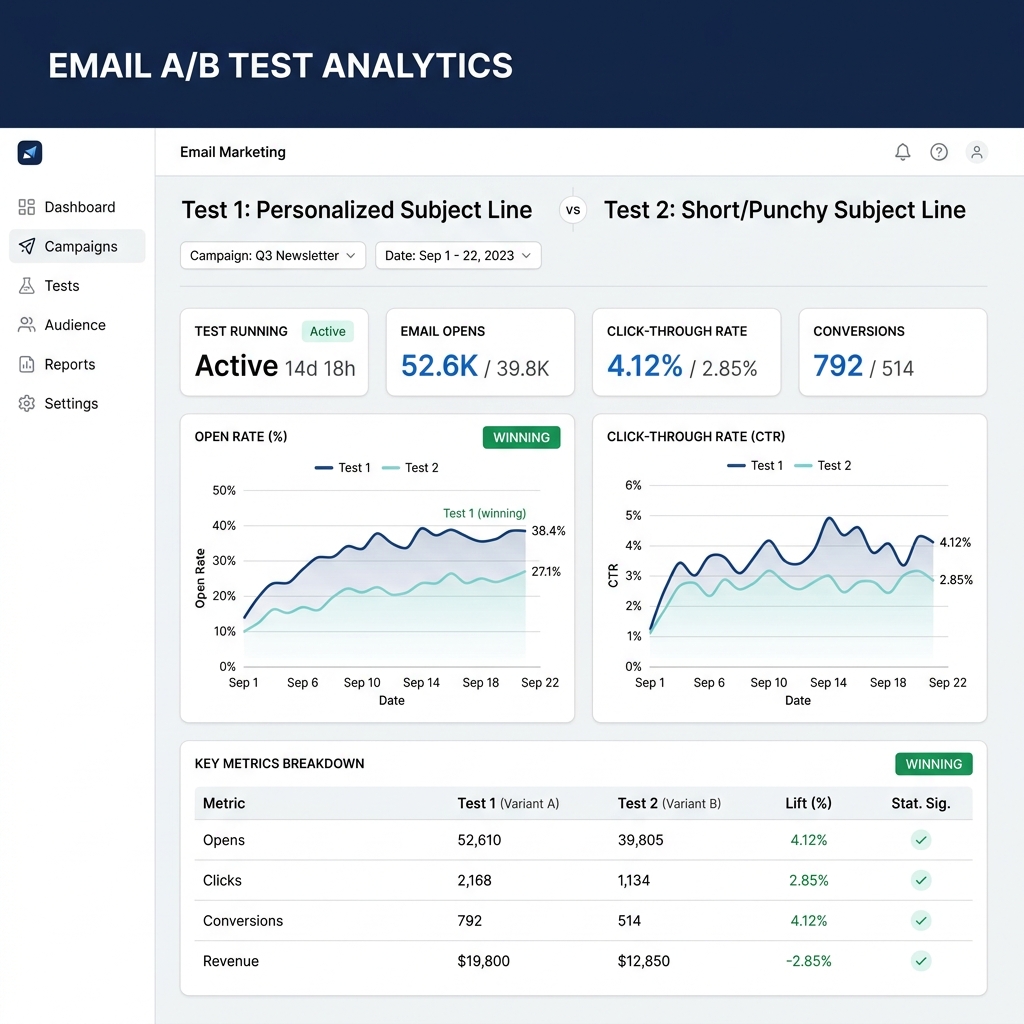
Your subject line is the only part of your email that 100% of your recipients will see. Everything else is conditional on that first impression.
That makes it, arguably, the highest-leverage word in your entire marketing operation. And yet most email marketers write their subject lines in five minutes based on gut instinct, send the campaign, and move on. They never find out if they guessed right. They just do the same thing next time, possibly with a slight variation, with equal confidence and equal blindness.
A/B testing breaks this cycle. It replaces gut feeling with evidence — not just about what worked once, but about how your specific audience thinks and what words move them to act.
Ready to stop guessing and start knowing what works? Build better subject lines with built-in A/B testing. Try Taildove for free
The mechanism is simple enough. You write two versions of a subject line, send each version to a portion of your list — say, 20% each — and let them run for a few hours. The version with the higher open rate goes to the remaining 60%. The winner becomes data you actually own: real evidence about your real audience, not a best practice copied from someone else’s industry.
But the real value isn’t the winning email. It’s the pattern you discover over months of testing.
What You’re Actually Learning
Most marketers run A/B tests looking for a winner. Smart marketers run A/B tests looking for a principle.
If question-format subject lines (“Are you making this mistake?”) consistently beat statement-format ones (“The top 5 mistakes you’re making”) for your list, that’s not just useful for one campaign — it’s a strategic insight about how your audience engages with uncertainty and curiosity. If first-name personalization lifts opens in your B2C campaigns but does nothing in your B2B ones, that tells you something real about the relationship your subscribers expect with your brand.
Each test is a small investment. The accumulated understanding is enormous.
3 Things Worth Testing First
-
Length: short and punchy versus long and descriptive. The conventional wisdom says short wins, and for many lists it does. But “The single biggest mistake I made scaling to $1M in revenue” often beats “My biggest mistake” because it gives readers enough context to know the email is for them. Don’t assume — test. Your audience will tell you what they prefer, and it may surprise you.
-
Framing: urgency versus curiosity versus usefulness. “Last chance to save 30%” creates urgency. “The thing your competitors figured out last year” creates curiosity. “How to cut your email unsubscribe rate in half” promises usefulness. These are fundamentally different emotional registers, and different audiences respond differently to each. Find out which one your subscribers reward with their attention — and be honest with yourself about whether your urgency subject lines are actually honest.
-
Tone: professional versus conversational. For some audiences, “Q1 Benchmark Report: Email Engagement Trends” feels appropriately serious. For others, “We ran the numbers and this is wild” gets twice the opens. B2B marketers in particular tend to default to formal language because it feels safe, when their subscribers might actually respond better to something that sounds like it came from a person rather than a department. Test the tone you’re afraid to use. The results are often illuminating.
The Rules That Make Testing Valid
Test one variable at a time. If you change the subject line and the sender name in the same test, you can’t know which one caused the outcome. Keep everything else identical and isolate the variable you’re measuring.
Test with a large enough sample. A test sent to 40 people proves nothing — any result could be statistical noise. The minimum meaningful sample size varies by list, but as a rough guide, you want at least a few hundred recipients per variation before you trust the outcome.
Wait long enough before declaring a winner. Most email opens happen in the first four hours after delivery, but some lists skew later. Give your test a full day before pulling the results, especially if you’re testing subject lines for a global audience in different time zones.
Build a Testing Library
After six months of consistent A/B testing, you won’t just have better subject lines. You’ll have a library of evidence about your audience — what they respond to, what they ignore, what they find compelling versus gimmicky. That library is a competitive advantage that compounds over time.
Document your tests. Write down what you tested, what the results were, and what principle you’re extracting from the data. The subject line you write in January should be informed by everything you learned in the previous twelve months.
Your subject line isn’t a guess. Make it a conversation you’ve been having with your audience for a year.
[!IMPORTANT] Start Testing Today Take the guesswork out of your marketing. Try Taildove’s A/B testing tools for free today.
Ready to boost your deliverability?
Join 2,000+ businesses sending better email with Taildove.